

There is a whirlwind of ways to pay for a heat pump here in Colorado right now, and that is a good thing! Rebates, tax credits, and low-interest loans are stacking up in ways we have never seen before.
In this article, we’ll cover one of the best ways to finance your heat pump installation project in Colorado, with the lowest interest/financing rate out there (without any credit check) from what we know as well.
This is called the CCEF On-Bill Repayment Program, which you may also see called “ClearPath On-Bill” with Xcel Energy. It is run by the Collective Clean Energy Fund (CCEF), the same organization behind the RENU loans that so many of our Denver Metro customers already use.
In a lot of cases, it beats everything else out there. In this article I want to walk you through what On-Bill Repayment is, how it differs from a RENU loan, who qualifies, and how to apply.
Let’s dive in!
What Is The CCEF On-Bill Repayment Program?
The On-Bill Repayment Program (OBR for short) is a state-supported financing option. It lets you install a heat pump with no money down, then pay the cost back as a small line item on your monthly utility bill.
It is run by the Collective Clean Energy Fund (CCEF), the same nonprofit behind the RENU loan program we have written about before.
CCEF puts up the money up front, and your utility simply collects the repayment on your regular bill. For most of our Denver Metro and Front Range customers that utility is Xcel Energy, and the Xcel version of this program is called ClearPath On-Bill.
In plain terms, CCEF pays for your project and you get your heat pump. Then you pay it back a little at a time, right on your Xcel bill.
There is no separate loan payment to track and no lump sum due at the end. This is a genuinely new tool in the toolbox, and we are proud to be an approved contractor for it.
This method of financing is also popular throughout the United States, with a reported (at the time of this writing) over $630M in financing similar projects across the country. So it’s popular!
What Does “On-Bill” Actually Mean?
This is the piece that makes the program so different, so I want to spend a second on it. With a normal loan, the debt belongs to you.
It shows up on your credit, and you make a separate monthly payment to a bank or credit union. With On-Bill Repayment, the obligation is tied to the electric meter on the property instead of to you personally.
That leads to a few things that surprise people, in a good way:
- No credit check and no new personal debt. Because the repayment is tied to the meter rather than to you, there is no credit pull and no underwriting.
- It can transfer when you sell. If you move before the balance is paid off, the remaining obligation can stay with the property and pass to the next owner, as long as everyone agrees and it is disclosed during the sale.
- You own the equipment from day one. The heat pump is yours the moment it is installed, and ownership only follows the home if and when you sell.
I think of it as financing that stays with the house, not with the person. For a lot of homeowners, that is a big deal.
How Is This Different From A RENU Loan?
We get this question a lot already, so let me lay the two side by side. Both come from CCEF, but they work very differently.
| RENU vs. On-Bill | On-Bill Repayment (ClearPath / Xcel) | RENU Loan |
|---|---|---|
| Interest rate | Roughly 4.5% to 5.5% (fixed) | Around 7% to 11%+, based on credit and term |
| Credit check? | No | Yes (income, credit, history) |
| Debt tied to | The property’s meter | You, personally |
| How you repay | A line item on your Xcel bill | A separate monthly loan payment |
| Term length | Up to 10 years | Up to 15 years for heat pumps |
| Max amount | $50,000 | Up to $75,000 |
The headline for most people is the interest rate. On-Bill Repayment currently lands around 4.5% to 5.5%.
A RENU loan, a HELOC, or a personal loan can easily run 7%, 9%, 11%, or more, depending on the market and your credit. (Rates change over time, so please confirm the current numbers with us or with CCEF when you apply.)
That said, RENU still wins in a few situations. Examples are when you want a longer 15-year term or need to borrow more than $50,000.
Every home and every budget is different, so we are happy to talk through which one makes more sense for you. We do not make anything on either program, we just like having good options on the table.
What Type Of Financing Is It? (The Terms)
Here are the specific terms for the Xcel ClearPath On-Bill program, as CCEF shared them with us directly during our contractor training:
- Interest rate: Fixed, ranging from 4.50% to 5.49%. One important note: the rate is tied to the length of the term, not your credit score. A shorter term gets you the lower rate, and a longer term carries a slightly higher one.
- Terms available: 3, 5, 7, or 10 years (fixed).
- Maximum financed: $50,000 (this limit applies per person, not per meter).
- Minimum financed: $1,500.
- Origination fee: A one-time 2% fee.
- No prepayment penalty. You are welcome to pay extra each month or pay it off early with no penalty.
- No money down. CCEF funds the project up front.
Who Qualifies For On-Bill Repayment?
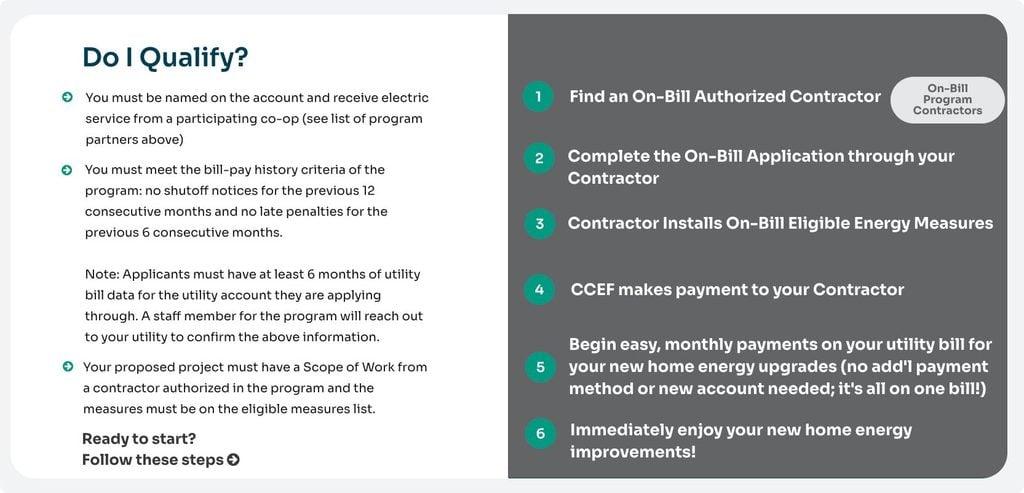
Because the program is tied to your utility account, the qualifications look a little different from a typical loan. Here is what needs to be true, as we understand it:
- You are an Xcel Energy customer (for the ClearPath version) in a participating territory (like the Denver Metro).
- Your home is individually metered. Shared meters, where multiple units run off a single utility account, do not qualify.
- You are listed on both the deed and the utility bill. The homeowner and the account holder need to be the same person.
- You have enough billing history. This generally means 6 to 12 months of utility history at the property. If you recently bought the home, Xcel may be able to count your history at a previous Xcel-serviced address if the bill was in your name.
- Your household income is at or above 81% of the Area Median Income (AMI). AMI is simply a benchmark for typical household income in your area, and this counts your whole household’s income, not only the person applying.
That AMI piece is a firm requirement of the program, so it is worth checking before you set your heart on it. The good news is you can look it up for your exact address in about two minutes.
It depends on your household income, and how many residents live in the home, zip code, County, City, and possibly more:
Check your AMI here: Fannie Mae AMI Lookup Tool. Just type in your address, and you will see the Area Median Income for your location.
If you are not sure whether you check all these boxes, do not worry. Sorting this out is part of what we help with.
How Do I Apply For On-Bill Repayment?
This is the easy part, because the application runs through your contractor. Since we are an approved On-Bill contractor, here is how it works when you go through us:
- We talk through your goals
- We plan a visit to your home and do lots of testing, chat about the specifics, and gather all the information we need for a very detailed heat pump design.
- We design your project and present all the science-backed design points and pieces of data, along with our proposal for the best cold climate heat pump to fit your home.
- You approve the proposal and we start planning for installation!
- We (the contractor) submit your application through CCEF’s financing portal and enter your utility account information.
- Xcel reviews your billing history to confirm eligibility.
- Once you are approved, we install your system. CCEF funds the project and sends the payment direct to us (the contractor).
- Repayment begins on your Xcel bill as a simple monthly line item, for a term you choose of up to 10 years.
- Enjoy your new cold climate heat pump!
That’s it! You get your heat pump, and the cost shows up neatly on the utility bill you are already paying every month.
A Few Common Questions
What happens if I miss a payment?
Since the charge lives on your Xcel bill, it is treated like the rest of your electric charges. A missed payment follows Xcel’s normal process, the same as if you fell behind on your regular electricity bill.
Can I still use rebates if I finance this way?
Yes, and you should! Any rebates you qualify for at the time of install can be applied to lower the amount you finance, so you are only paying back the net cost.
We handle the Xcel and other rebates for you and apply them as an up-front discount, so this part stays simple.
Is there anything on my utility account that could hold me up?
Your account generally needs to be in good standing. That means no shutoff notices in the last 12 months and no late payment penalties in the last 6 months.
Wrapping It Up
On-Bill Repayment is one of the more exciting financing tools I have seen come through in a while. It is especially good for homeowners who want a low fixed rate without a credit pull or a brand new loan payment to manage.
With rates around 4.5% to 5.5%, no money down, up to $50,000 available, and the balance tied to the home rather than to you, it opens the door for a lot of folks who were on the fence about going electric.
And also – the program is not limited to heat pumps, so if you are already doing a project you can often pair it with other upgrades like insulation, air sealing, a heat pump water heater, or new windows and doors.
There is always more detail under the hood, and the exact numbers and rules can shift over time. Think of this as a solid starting point rather than the final word.
We are also not tax or financial professionals, so please check with your CPA or financial advisor on anything specific to your situation.
If you have any questions at all, or if you would like to explore financing a heat pump through the On-Bill Repayment Program, please reach out to us here. We love walking through these options with Denver Metro and Front Range homeowners, and we will help you figure out whether On-Bill, RENU, or something else is the best fit.
Thanks so much for reading, and until next time!


