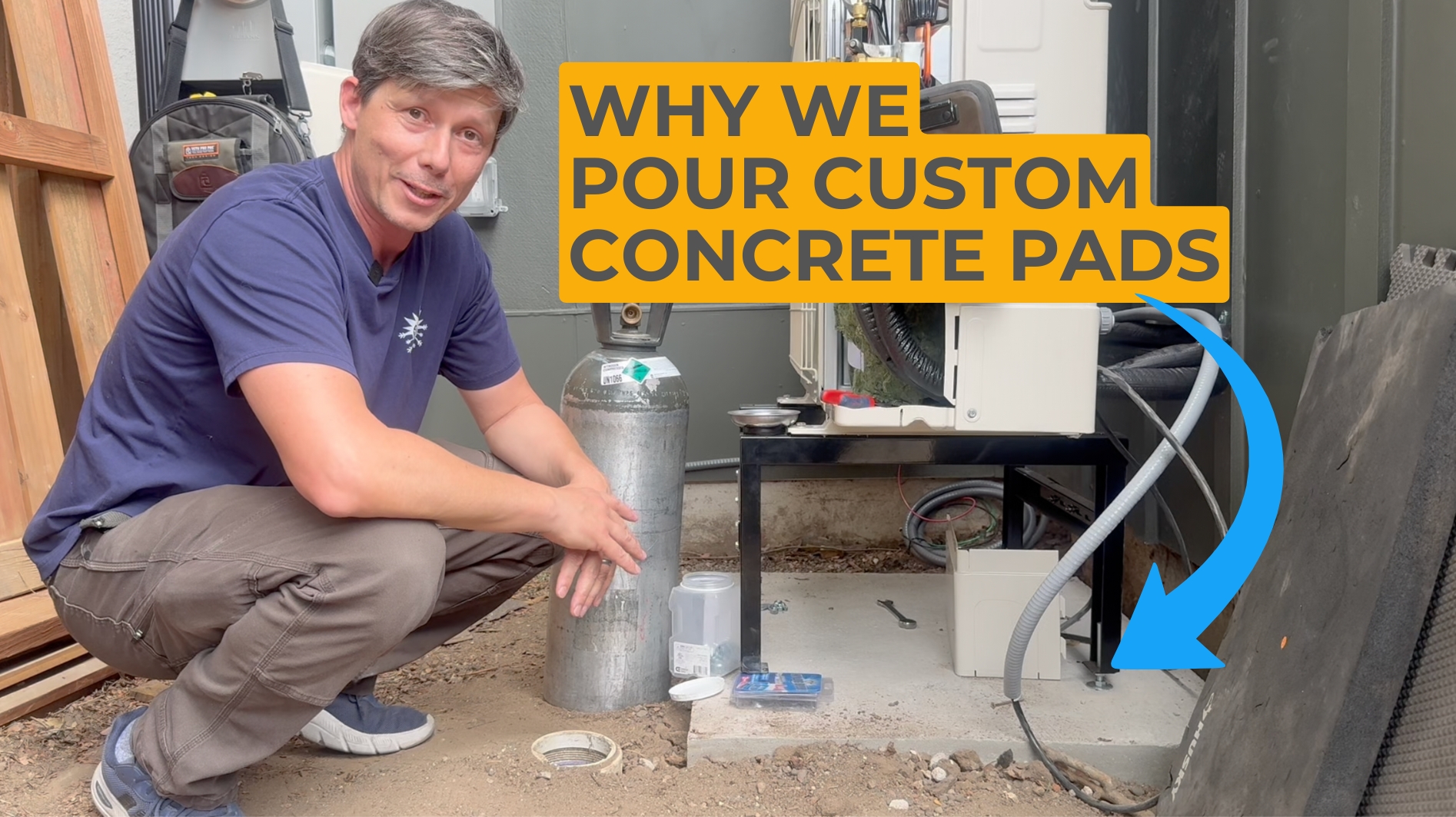
We probably don’t market it or share it well enough, but it’s a little known fact that we custom pour concrete pads for each of our heat pump installs?
Is it a ton of extra work, time, and cost? Yes! But we feel it’s well-worth it. Heat pumps are a 15-20+ year endeavor, and in this short video clip (with the transcript below), Xerxes Steirer, one of our CoFounders, goes into detail on why.
While most pads used out there are faux concrete with styrofoam in the middle (very light) or just plastic, we want to provide a solid 350 to 500 lb concrete pad specifically for the outdoor heat pump condenser, so it never moves, is quieter, produces less vibration, and more.
Additionally, Xerxes talks about the benefits of ground mounting if at all possible and not wall mounting, though every circumstance is a little different. Check out the video, and the full transcript is below too.
Enjoy!
Transcript:
One of the top quality aspects of our work here is to make sure that we put in solid foundation for your heat pump. So we’ll come out before the install, we’ll prep the area, and then we will create a form and reinforce a concrete pad.
This weighs between 350 and 500 pounds, depending on the size of the pad, and it really creates a very solid base, whether there’s windy conditions, any kind of gentle slope that we need to deal with, as well as some other kind of advanced features we use on our stands.
And this is one of the highest quality aspects because it not only creates a stable stand and placement for decades, but it also reduces noise. And it reduces noise because it’s got such a large mass, and that mass is really essential for a quiet operation. Standard in the trades, which we don’t do, is plastic or spray concrete-covered styrofoam.
And these are so easy to place. They can do it same day. They save so much time and effort and energy and money that it makes sense for a lot of companies, budget companies to do that. One of the things that we decided very early on was high quality, solid, heavy, and in-place formed concrete pads for stability, longevity, and minimal noise.
So the quietest operation is typically with the concrete. Another outdoor placement or bracketing or attachment or fastening system you see is Wall mounting is a wall bracket and you’ll see it all around town. And it is a very easy way to avoid the concrete and ground placement and sometimes certain code restrictions.
But in many cases, especially if it’s a wood wall, a wall that’s not incredibly heavy or very solid brick or block, you’ll get a lot of loud sound transfer through the wall, and that’s why we really try to avoid wall mounts whenever possible and go with concrete mounts. The wall mount, because you have inverter technology, ramps its compressor speed up, and it ramps its compressor speed down.
At one of those speeds, it will create a resonance, and it might last a couple of seconds or it might sit on that resonance and create a very loud indoor experience for you, especially if it’s outside your bedroom or a kid’s room or your dining room or anywhere you spend a lot of time. So it’s just something that we recognize.
There’s cases where it makes sense but by and large, we really do prefer the concrete install there as a ground-mount.
And if you want to see how ready you are for a heat pump, take our Heat Pump Home Readiness Quiz or contact us here to see if it might be a next step for you.
Thanks for reading!