UPDATE: The U.S. House of Representative passed in a 210-199 majority the Homeowner Energy Freedom Act (H.R. 4758), which seeks to repeal the HEAR Rebates nationwide.
We are in constant communication with the Colorado Energy Office and all associated parties to request/gather news on funding and what guarantees of HEAR funds may still be available, even if HEAR rebates are rescinded similar to the Inflation Reduction Act (IRA).
According the latest communication from the Colorado Energy Office on March 5, 2026:
- Home Electrification and Appliance Rebates (HEAR) Funding Update: The Colorado Energy Office (CEO) is aware of questions related to a proposed federal bill (i.e., H.R. 4758) and its potential impact on HEAR funding. Based on current information, we do not believe this presents a major concern for contractors. Key points include:
- Legislative status: While H.R. 4758 has passed the U.S. House of Representatives, it is very unlikely to pass the U.S. Senate.
- Colorado funding is already obligated: Recent federal proposals to cancel funding have focused on unobligated funds. Colorado’s HEAR funds have been fully obligated.
- Completed projects remain covered: Even if obligated funds were targeted, the U.S. Department of Energy has clear contractual obligations to cover costs for projects that have already been completed, including projects that are installed and approved but awaiting payment.
We will post updates here as soon as we here more on updates. For now, we move ahead assuming that the funds will remain available given the CEO’s recent great news. Please contact us directly if you have specific questions about the heat pump HEAR rebates and the latest.
HEAR Rebate Funding Update:
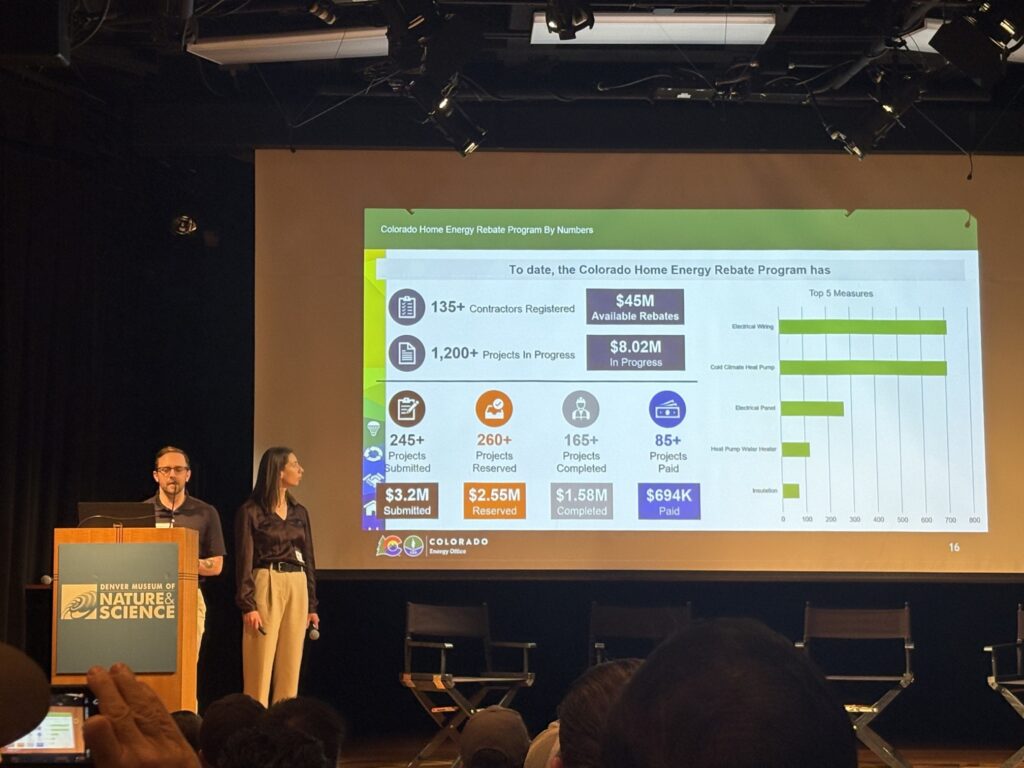
As EEBC members, we attended the latest EEBC meeting where the HEAR processing team was there in person to give us updates on the program, and to help everyone involved (including homeowners) move through the program smoothly.
They shared that of the $45M reserved for HEAR rebates, over $8M has been reserved already. Our take:
Even though the program is set to go for years to come, the funding is going really quickly just a few months in. Homeowners across the state are taking advantage of these rebates incredibly fast.
Original Article:
We live in exciting times in Colorado right now for home electrification and the heat pump movement. As of late 2025, we already had some of the best heat pump rebates and incentives in the U.S. within the Denver metro area. And now a new program – the Colorado Home Electrification and Appliance Rebate Program (HEAR) – is here!
This exciting new rebate program will add thousands of dollars to heat pump incentives alone, and even more for accompanying upgrades such as heat pump water heaters, electrical panel upgrades, air sealing, insulation, and more.
And even better, these new HEAR program rebates are able to stack on top of other incredible rebates, such as the Xcel Energy Heat Pump Rebate program, the Colorado State Heat Pump Rebate, the Xcel Whole Home Efficiency program, and more (up to certain limits).
In this article I’d like to describe what the HEAR heat pump rebate program is, how you can check to see if you’re eligible, and then how the process goes if we install a heat pump for you in order to maximize the funds available.
We are also approved contractors in the HEAR program, so if you have any questions on it, please reach out here and we’re happy to help.
This article will focus on the HEAR program, but the separate HER Program (Home Efficiency Rebates) is still rolling out as well, and is tailored more towards manufactured/mobile homes and large multifamily building (50,000+ sq ft), slated to start up in early 2026.

Let’s get started!
What is The Colorado HEAR Heat Pump Rebate Program?
Funded from the original Inflation Reduction Act, the Colorado HEAR program funds have just now become available for Colorado income-qualified residents throughout the state for energy-efficient upgrades for their home.
Colorado was allocated approximately $140 million for the HEAR and HER programs, with the specific goal of helping to lower energy costs and reduce carbon emissions and greenhouse gases through home improvements. About one third of that pool is allocated for the HEAR program itself, or about $45M.
The HEAR program funds are available:
- Single-family homes
- Apartments
- Condos
- Manufactured/Mobile Homes
What is The General Process or Steps to Get These Rebates?
These are the general steps, in order, to take advantage of these HEAR rebate funds for heat pumps:
- Check your (estimated) eligibility and AMI income limits for your County and household size. See below for further details on this.
- Find a Registered Contractor – You must use approved/registered contractors in the HEAR program for all upgrades you do (we’re approved for heat pumps).
- You must become officially qualified/approved through the official Colorado Energy Office (CEO) website and their specific application process. As of April 2026, the CEO has recently changed their process, and are requesting that the application link and initiation be started by your chosen contractor for the work. This is why you may find it removed from the HEAR Website.
What does this mean for you? You’d want to start researching approved contractors in the program above and decide who you’d like to go with for each type of project. From there, the contractor should be able to share the qualification details and instructions with you.
Our process at Just Heat Pumps:
Start by reaching out to our team of heat pump experts to get some initial information, heat pump engineering, a quote including all the HEAR details.
You can email us here, or feel free to call us directly during business hours at 303.525.HEAT (4328). From there we will help you get started, and we would move towards a home visit and the HEAR qualification steps in tandem or at the same time.
*Lately the HEAR office has been taking 2-4 weeks for qualification of homeowners due to popularity of the program. - Once qualified, email (forward) the qualification letter to your chosen contractors so they can confirm your rebate tier level.
- Complete a Home Assessment – Your chosen registered contractor will examine your home and explore/determine ways to make it more energy efficient, and to design and specify the right equipment.
- For heat pumps – we do a thorough 1-2 hour home visit where we speak to you about your goals, collect information, and do multiple different HVAC tests to determine the best new electrified heat pump size and equipment rooted in engineering and design.
- Please see our blog/Learn posts and YouTube channel for more on heat pumps specifically for Colorado.
- Install Improvements and Equipment – We schedule and install the equipment, and the rebates must also be subtracted from the overall project cost. This means that your up front cost will be lower.
- Enjoy your new energy efficient home with new electrified equipment! Benefit from improved energy bills, more comfort, cleaner air, and much more.
Who Qualifies For The HEAR Heat Pump Rebates?
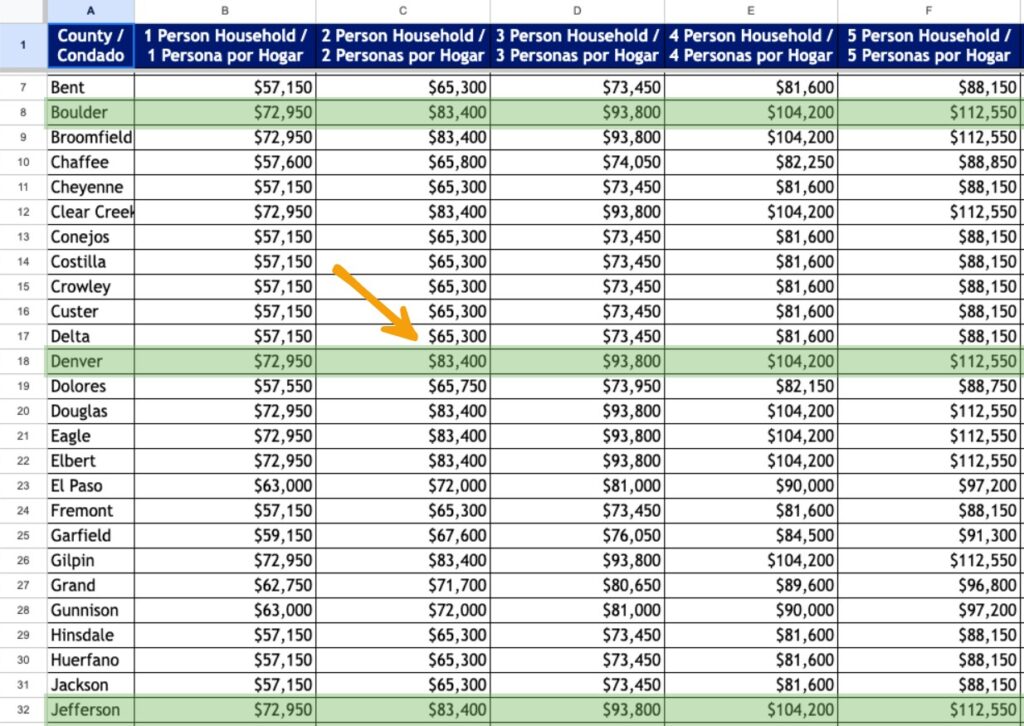
Any Colorado resident who meets the programs income qualifications can qualify. The program uses local AMI (Area Median Income) data specific to your county and by the number of people in your household in order to determine your rebate levels:
| Income Level | HEAR Rebate Amount – Heat Pumps |
|---|---|
| Below 80% AMI | 100% of qualified project cost, up to the HEAR maximum rebate amounts. For heat pumps HVAC specifically – this tier is $8,000 for qualified homeowners and heat pump equipment. |
| 80% – 150% AMI | 50% of qualified project cost, up to the HEAR maximum rebate amounts. For heat pumps HVAC specifically – this tier is still up to $8,000 for qualified homeowners and heat pump equipment with how the pricing usually works out. |
We have listed the exact qualification and documents needed below to determine which tier you might be in, but you can start with just having a look at rough numbers for now.
To do this, the Colorado Energy Office has given us two great Google Sheets tables to use to determine your eligibility. You’ll have to check both for possible qualification on the income levels. Here are the links to the Google Sheets:
Start with your County on the left side (Column A), then go across the row under how many people are in your household to determine your own personal AMI limit/number:
Up to 80% Area Median Income (AMI) Chart by County and Household Size for Fiscal Year 2025-2026
80% – 150% Area Median Income (AMI) Chart by County and Household Size for Fiscal Year 2025-2026
What Rebates Are Available For Heat Pumps?
Cold climate heat pumps are the largest rebate in the program. Non-cold climate heat pumps also
For the Below 80% AMI limit, you will receive an up front discount of $8,000 for a cold climate heat pump, and $3,000 for a non-cold climate heat pump.
For the 80% to 150% AMI limit income tier, you will receive 50% of that, or an up front discount of up to $8,000 for a cold climate heat pump.
Don’t Forget About Electric Upgrades
For even more rebates through HEAR, we’ve confirmed with HEAR that our electrical upgrade work as part of a heat pump installed is available in addition to the heat pump rebate.
| Income Level | HEAR Rebate Amount – Electrical Wiring |
|---|---|
| Below 80% AMI | 100% of qualified project cost, up to the HEAR maximum rebate amounts. For electrical wiring specifically – this tier is up to $2,500 for qualified homeowners and electrical wiring needed in conjunction with a heat pump. |
| 80% – 150% AMI | 50% of qualified project cost, up to the HEAR maximum rebate amounts. For electrical wiring specifically – this tier is still up to $2,500 for qualified homeowners and electrical wiring needed in conjunction with a heat pump. Oftentimes the 50% level is more realistically a rebate of between $1,000 and $2,000 however. |
You can check out the real example project below for a look at what the whole project might look like.
Wait, What is a Cold Climate Heat Pump?
What is a cold climate heat pump and why do they get more in rebates? Cold climate heat pumps are basically the latest and greatest electrified heating and cooling technology.
They cost a little bit more up front versus generic/standard heat pumps, but they specifically can heat your home at near full capacity all the way down to 5 Fahrenheit or lower. For example – if your home might need a 3.5 ton heat pump when it’s 5F outside – these cold climate versions can heat your home at or near that 3.5 tons of heating needed. Regular heat pumps lose heating capacity rapidly as the outside temperature approaches zero, and this is the difference.
Not only will cold climate versions heat near or at full capacity when it’s close to 0F outside, they now operate reliably all the way down to -13F or even lower, completely eliminating the need for natural gas (furnance/boiler/dual fuel) heating backup systems for your home.
What Determines Your AMI Income Eligibility?
You may be able to at least start with a rough number, but to be sure, you’ll have to go through their application process. So far the process has not taken homeowners long at all (as seen from our heat pump customers) which is great news. Here are required documents they need to start:
- Photo ID (e.g., driver’s license, state ID, U.S. Passport)
- Proof of ownership if you own the property (e.g., deed, tax record, homeowner’s insurance document)
- Proof of renter status or residency if you rent the property (e.g., lease, renter’s insurance document, utility bill, government-issued document)
- Proof of landlord permission if you rent the property (Landlord Authorization for Participation Form will be provided)
- Proof of income if you apply for income-qualified rebates (see options below)
The list is long for verification of your income, so bear with us! There are a two options to demonstrate/determine income levels for the program:
There are two tiers of rebate levels for this program:
Option 1: Show Your Household is Enrolled in an Approved Program
Taken directly from the CEO Hear website:
Provide a benefit letter (must be valid and not expired as of the date of application) that proves someone in your household is currently enrolled in one of the programs listed below. For multifamily buildings, documentation is required for at least 50% of the households in the building. Approved programs include:
For Households:
- Low Income Home Energy Assistance Program (LEAP)
- Medicaid
- Supplemental Nutrition Assistance Program (SNAP)
- Head Start
- Lifeline Support for Affordable Communications (Lifeline)
- Food Distribution Program on Indian Reservations (FDPIR)
- National School Lunch Program – Free (NSLP)
- Housing Improvement Program (HIP)
- Supplemental Security Income (SSI)
- Aid to the Blind (AB)
- Aid to the Needy Disabled (AND)
- Old Age Pension (OAP)
Option 2: Provide Acceptable Documentation to Verify Household Income
Provide documentation of your household income from the past 12 months. For multifamily buildings, documentation is required for at least 50% of the households in the building. Acceptable documents include:
- IRS Form 1040 – a copy of your tax return from the past 12 months
- IRS Form W-2 – from the past 12 months
- IRS Form 1099s – from the past 12 months
- Paystubs or wage statements – two in a row from the past 2 months
- Cash income records – bank statements or payment apps like Zelle or Cash App from the past 3 months
- Unemployment benefits letter – must show you are currently receiving benefits
- Military, pension, or retirement benefits letter – from the past 12 months and must show current enrollment
- Supplemental Security Income (SSI) or Social Security Disability Insurance (SSDI) letter – from the past 12 months and must show current enrollment
- Alimony letter – from the past 12 months and must show current enrollment
- Worker’s compensation benefits letter – from the past 12 months and must show current enrollment
You can start your application process here as a reference again.
An Example of a Heat Pump Rebate Project With Current Rebates Combined
Going into 2026, the rebates and tax credits are shifting around a bit. I wanted to provide a quick example of what a real heat pump installation might look like with the HEAR rebates and also the others combined.
*As a caveat – I must start by saying that every single home is different, and requires a strict testing and design process from the heat pump side of things. In order to see about your home own, feel free to contact us for an evaluation if you like.
The example below is purely generic for now, but close to many real-world heat pump installations we do:
3 Ton Cold Climate Heat Pump Project With Rebates Example – 100% Tier:
| Total Price for Installation Including Electrical & Electric Heat Strip Backup: | $24,000 |
| Xcel Energy Heat Pump Rebate (we discount up front): | -$6,190 |
| 2026 Colorado Heat Pump Tax Credit (we credit fully up front): | -$1,000 |
| Colorado Hear Program Rebates (under 80% AMI County eligibility – up front discount): | -$8,000 |
| Electrical Wiring Rebate | -$2,500 |
| Net Cost of Heat Pump: | $6,310 |
In the above real example, you can see that rebates and incentives make up about 74% of the total cost of a cold climate heat pump installation. This is truly incredible.
Typical furnace and A/C combo replacements and boilers are usually double, if not triple the cost of the net cost of heat pumps after it’s all said and done, which truly makes this a no brainer.
This is just an example and every home is different. There are many, many steps and requirements from the contractor-side of things in order to secure these. As contractors though, we take care of most of this in order to make your installation as easy as possible.
What Other Rebates Are Available?
Taken from the HEAR website itself, here is the table of all the different electrification upgrades that qualify:
| Eligible Upgrade | HEAR Maximum Rebate Amount Per Household/Unit |
|---|---|
| Heat pump water heater | $1,750 |
| Cold climate heat pump for space heating and cooling | $8,000 |
| Heat pump for space heating and cooling | $3,000 |
| Electric stove, cooktop, range, or oven | $840 |
| Electric load service center (also known as electric panel) | $4,000 |
| Insulation, air sealing, and ventilation | $1,600 |
| Electric wiring | $2,500 |
| Total maximum rebate | $14,000 |
As we speak to homeowners and plan our heat pump installations, here are some more things to consider when looking into HEAR –
Start With An Energy Audit
No matter what projects you may want to do, it often makes total sense to start with a BPI certified energy audit to know exactly what your homes starting point is, and to let the report tell you what your lowest hanging fruit is.
If you’re in the Xcel Energy territory for utilities, be sure to go through their program and approved auditing contractors (we’re one of them also), as it sets you up for their Whole Home Efficiency program and bonus rebates too.
The benefits of an energy audit are countless, but here are some main ones (especially as it relates to heat pumps):
- It’s by far the cheapest thing you can do for the more important information about your home. It’s essentially an X-Ray that tells you what you need to do first.
- By knowing where and how to air sealing and upgrade insulation, we can often install a smaller-sized (and right-sized) heat pump. This means even more comfort and lower energy bills for 15-20+ years.
- Air sealing and insulation is biggest bang for the buck in terms of home energy efficiency in almost every circumstance.
- A better building envelope means lower up front costs for bigger projects like heat pumps, solar, and more. When your walls, ceilings, and floors don’t leak as much, you pretty much need less of everything!
- Extended equipment and lower maintenance – when your home is tighter and well insulated, all the systems in the home just don’t need to work as hard.
Recommended Rebates to Go For Along With a Heat Pump
Electrical Panel Upgrade
The first one includes the electrical panel upgrade to go for in the $4,000 top tier. Since many of the incentives (Xcel Energy and others too) are to incentivize moving away from natural gas, we naturally need more space and capacity in your electrical panel.
It’s common for our heat pump projects to need 2, 3, or even 4+ 240V 2 pole breakers (the bigger ones) to size and run your heating and cooling properly with a cold climate heat pump.
In addition – upgrading your panel allows for new heat pump water heaters, induction stoves, EV charger breakers, and much more.
Since HEAR gives up to $4,000 for the panel upgrade, this is a great one to accompany any major electrification upgrade.
For a typical Home, a panel upgrade is usually around $5,500 to $7,000 before rebates depending on your exact needs.
Heat Pump Water Heater Upgrade
HPWH’s are regular tank water heaters that use a heat pump inside it to heat the water from the surrounding ambient air in your utility room, closet, or wherever you install it. They are very efficient and is another incredibly popular way to heat your water while electrifying and moving away from natural gas.
Not only does HEAR give up to $1,750 for this one, but so does Xcel Energy! That’s $3,500 right there. Not only that, the Colorado state heat pump tax credit gives another $250, and cities and counties can add even more with their own incentives.
You must go through a qualified contractor to get all the rebates, but when all added up, the rebates should pay for at least 50% or more of your new heat pump water heater.
You can add on the electrical wiring HEAR rebate to this one too, because most new HPWH’s use a 30 amp 2-pole breaker or something close to that (its own dedicated circuit is needed).
Some Final Thoughts and Resources
There’s much more to the program, but I didn’t want to make this article longer than it already is. The Colorado Energy Office has some great resources. Check them out here (which will continually be updated):
Colorado Home Energy Rebate Program FAQs
Click Here to download the Single Family HEAR Program Flyer PDF

This is truly an incredible program and we are lucky to be in Colorado with this many rebates right now for home electrification, sustainable upgrades, cleaner air, lower energy bills, and much more.
There’s a lot to this program, but we tried to outline for you to at least give you the starting point. If you’re curious about it at all, we do recommend to start your application with the Colorado Energy Office in order to become qualified.
And of course, we’d love to help you with your electrified cold climate heat pump! We also often pair heat pump water heaters (HPWH’s) and electrical panel upgrades while we’re doing the electrical work for the new heat pump as well.
If you have any questions at all, or if you’d like to explore a heat pump under this program for yourself, please reach out to us here.
Thank you for your time, and we appreciate it!